Blog
Ashwagandha (Asgand Nagori): Uses, Forms and Safety Guide

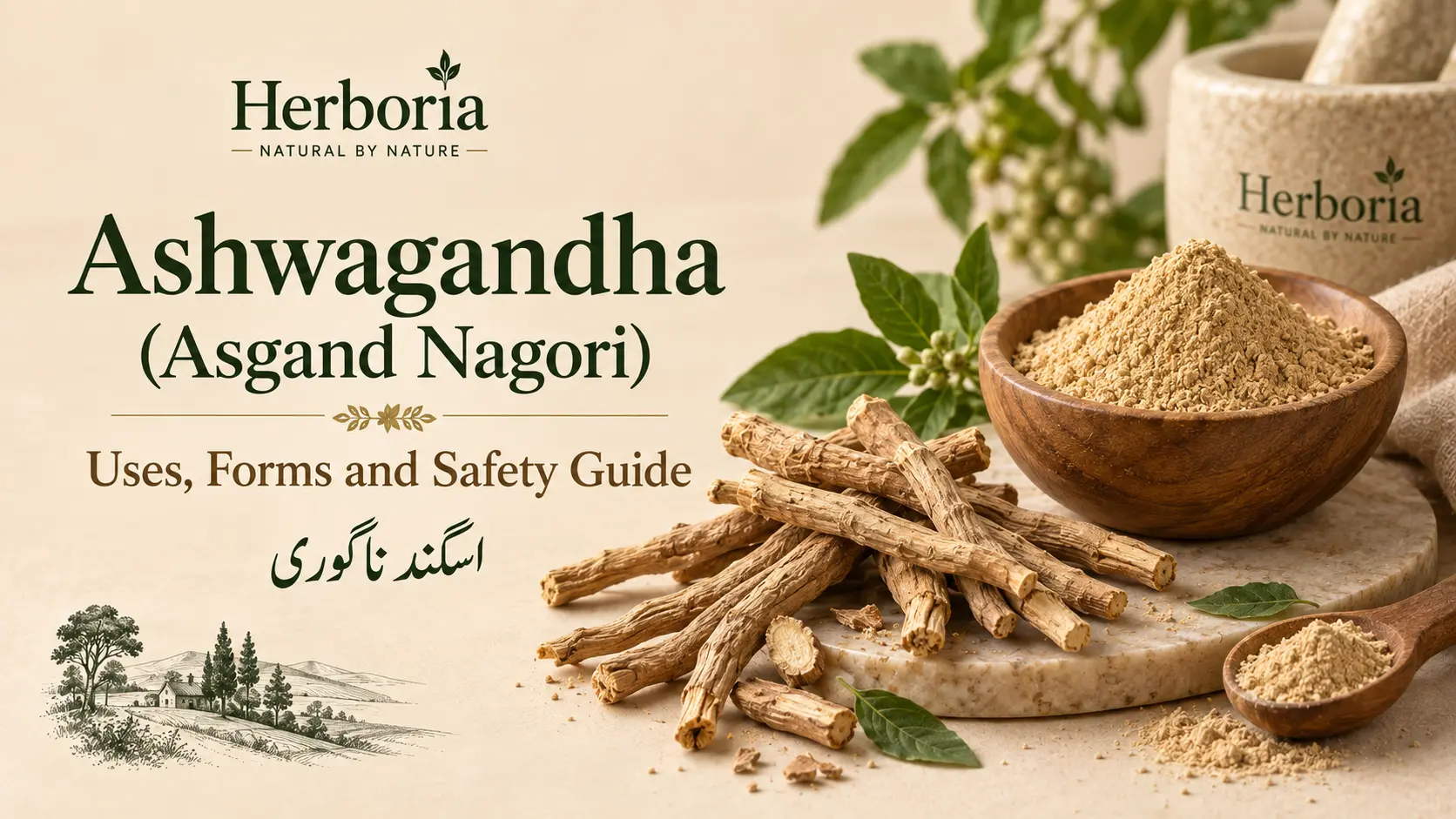
Ashwagandha, commonly associated in Pakistan with Asgand Nagori (اسگند ناگوری), is a traditional root ingredient from Withania somnifera. It is sold as whole dried root, powder and supplement preparations. Traditional use is broad, but modern evidence is much narrower, so a responsible guide should separate cultural use, product form, research findings and safety precautions.
If you are searching for ashwagandha uses in Urdu, the useful starting point is not a long list of cure claims. It is understanding what the herb is, what form you are buying, what evidence can and cannot support, and when professional advice is appropriate.
What Is Ashwagandha / Asgand Nagori?
Ashwagandha is the common English-market name for Withania somnifera, a plant with a long history in traditional Ayurvedic use. In Pakistan’s pansar market, Asgand Nagori is a familiar local/trade name associated with the root.
Herboria currently lists both Asgand Nagori Powder / root product and Ashwagandha Powder (Asgand Nagori). Both listings identify the ingredient as Withania somnifera, but names and forms can vary between sellers, which is why the label matters.
Ashwagandha in English and Urdu
| Name type | Common wording |
|---|---|
| English/common market name | Ashwagandha |
| Local / pansar name | Asgand Nagori |
| Urdu | اسگند ناگوری |
| Botanical name | Withania somnifera |
People sometimes search for “Ashwagandha” and “Asgand Nagori” as if they are two unrelated products. Herboria’s current listings connect both names to Withania somnifera, but the detailed comparison is important enough to have its own supporting guide rather than overloading this pillar article.
Common Forms Sold in Pakistan
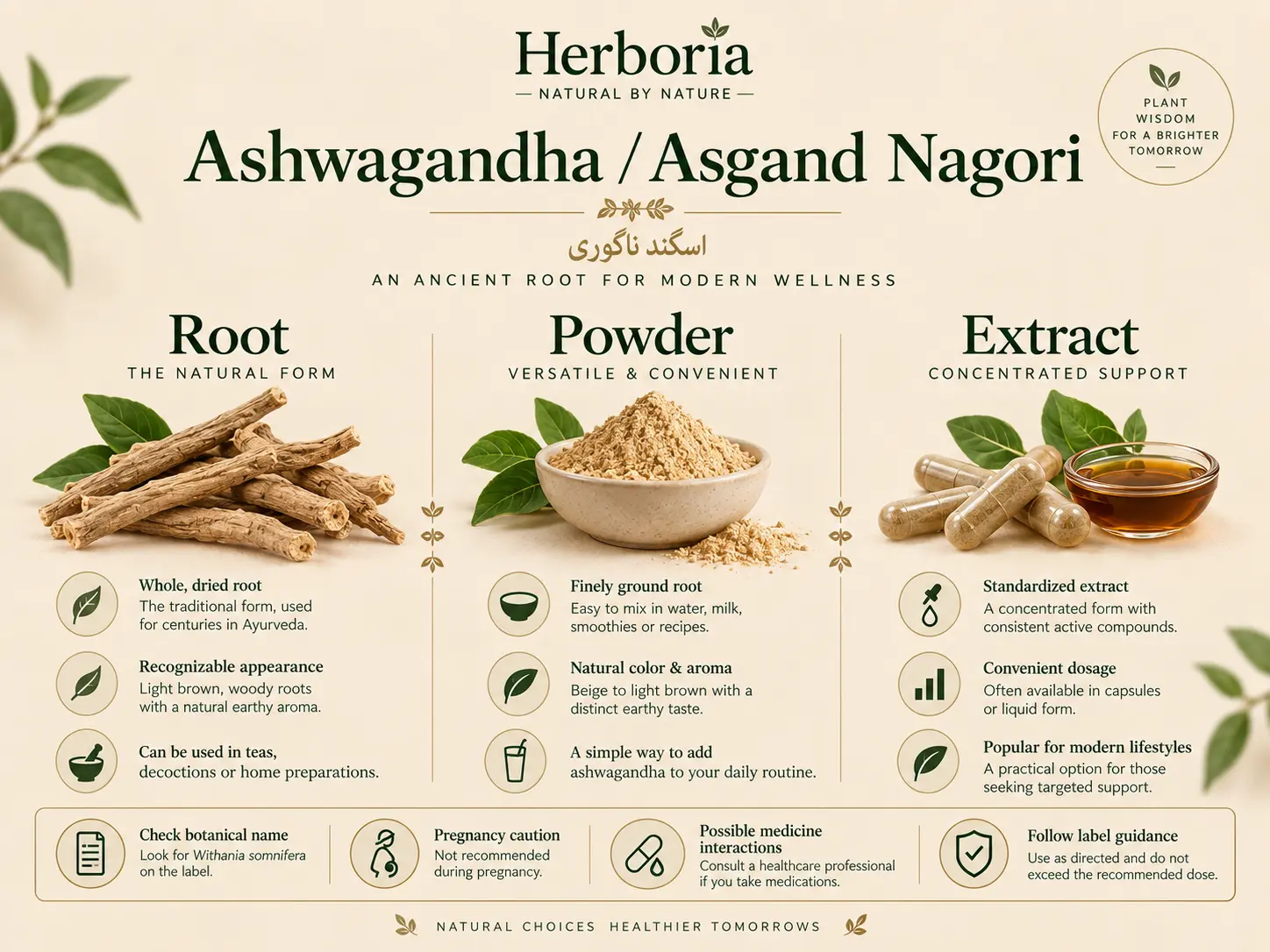
Whole or cut dried root
Whole-root form lets buyers see more of the raw ingredient and is common in traditional pansar trade. It usually requires more preparation than powder.
Root powder
Powder is easier to mix and measure in traditional preparations, but visual identification becomes more difficult after grinding. That makes ingredient transparency and reliable sourcing more important.
Capsules, extracts and supplements
Concentrated extracts and supplements are not automatically equivalent to ordinary root powder. Research studies may use specific extracts, concentrations and standardisations, so results from one preparation should not be casually transferred to every powder or supplement on the market.
Ashwagandha Uses in Urdu: What Does “Uses” Actually Mean?
In Urdu-language discussions, ashwagandha is often described through traditional uses related to general wellbeing, sleep, stress, energy, strength or reproductive health. Those traditions are part of the herb’s cultural context, but they should not be presented as guaranteed medical outcomes.
The U.S. National Center for Complementary and Integrative Health (NCCIH) notes that some ashwagandha preparations may help with stress and insomnia, while evidence for many other promoted uses remains insufficient or unclear. Studies also use different preparations and often have small sample sizes, so evidence should be interpreted cautiously.
What Research Can and Cannot Tell Us
Current research does not justify presenting ashwagandha as a cure-all. A more accurate summary is:
- Some studies suggest certain preparations may help with stress or sleep.
- Evidence for anxiety is not clear enough to make broad claims.
- There is limited evidence in some male fertility/testosterone research, but that does not establish a general benefit for everyone.
- There is not enough evidence to support many other commonly promoted health claims.
Most importantly, a research result for a specific extract does not prove that every raw root powder, capsule or traditional preparation will produce the same effect.
How to Choose Ashwagandha or Asgand Nagori
Check the botanical identity
Look for Withania somnifera where botanical naming is provided. Avoid products that rely on a benefit claim without clearly identifying the ingredient.
Check whether you are buying root, powder or extract
These are different product forms. A root powder should not be marketed as if it automatically matches a standardised extract used in a clinical study.
Check the ingredient list
If the product is marketed as a single-herb powder, the ingredient declaration should be clear. If other ingredients are added, they should be disclosed.
Check storage guidance
Dry roots and powders should be protected from moisture and contamination. Follow the current product label for exact storage instructions.
Be cautious with “guaranteed” health promises
Claims that a single herb will cure stress, infertility, thyroid disease, diabetes or another medical condition should not replace evidence-based care.
Safety and Precautions
Ashwagandha is biologically active and is not suitable for everyone. According to NCCIH, short-term use of some preparations may be tolerated by many adults, but long-term safety is not well established.
Reported side effects can include stomach upset, diarrhoea, vomiting or drowsiness. Rare cases of liver injury have also been reported in association with ashwagandha supplements.
Pregnancy and breastfeeding
NCCIH advises avoiding ashwagandha during pregnancy and says it should not be used while breastfeeding.
Medicines and health conditions
Ashwagandha may interact with some medicines, including medicines used for diabetes, high blood pressure, immune suppression, seizures, sedation and thyroid conditions. It is also not recommended in some situations such as before surgery or for certain autoimmune or thyroid disorders.
If you take prescription medicines or have a diagnosed condition, speak with an appropriately qualified healthcare professional before using an internal herbal product.
No Universal Dose Belongs in a General Buying Guide
This article intentionally does not provide a one-size-fits-all dosage. Different studies and products use different preparations and concentrations. A raw powder, an extract and a capsule may not be equivalent, and individual health circumstances matter.
Follow the product label and qualified professional advice rather than copying a dose from a social-media post.
Storage of Asgand Nagori Root and Powder
For dry root or powder, keep the product sealed, dry and protected from excessive heat, sunlight and moisture unless the label gives different directions. Use a clean, dry utensil and avoid introducing water into powder packaging.
Natural variation in root colour or powder shade can occur. Appearance alone is not a reliable test of potency, purity or medical effectiveness.
How This Fits Into Herboria’s Pansar Cluster
For the broader category context, read Herbs and Pansar Items in Pakistan: A Complete Beginner’s Guide. For other traditional roots and powders, see the Specialty Herbal Powders in Pakistan guide.
These guides deliberately separate general pansar buying education from ingredient-specific evidence and safety, which helps avoid making one broad article compete with more focused search intent.
Where to Buy Asgand Nagori / Ashwagandha
Herboria currently offers Asgand Nagori and Ashwagandha Powder (Asgand Nagori). Compare the form, ingredient description and current pack information on the live product page before ordering.
Quick Buying Checklist
- Is the ingredient identified as Withania somnifera?
- Is it root, powder, capsule or extract?
- Are added ingredients disclosed?
- Does the seller avoid guaranteed cure claims?
- Are storage directions provided?
- Are you taking medicines or managing a condition that could require professional advice?
- Are you distinguishing traditional use from research evidence?
Related Ashwagandha & Asgand Nagori Guides
This is the pillar article for Herboria’s Ashwagandha & Asgand Nagori cluster. Supporting articles HB-012 through HB-020 will address name equivalence, forms, storage, buying checks, evidence and safety questions in narrower depth. Each support article should link back to this pillar and to relevant siblings once live.
Frequently Asked Questions
What is Ashwagandha / Asgand Nagori?
It is a traditional root ingredient identified as Withania somnifera. Ashwagandha is a common English-market name, while Asgand Nagori is widely used in South Asian pansar contexts.
How is Ashwagandha commonly used?
It has a long history of traditional use and is sold as root, powder and supplement preparations. Modern research has studied selected preparations for areas such as stress and sleep, but evidence is not strong enough to support broad cure claims.
How should Asgand Nagori be stored?
Follow the product label. Dry root and powder should generally be kept sealed, cool, dry and protected from moisture and direct sunlight.
What precautions apply?
Ashwagandha can cause side effects and may interact with medicines. It should be avoided during pregnancy, and professional advice is especially important for people taking medicines or managing medical conditions.
Where can I explore Asgand Nagori / Ashwagandha products in Pakistan?
Review Herboria’s Asgand Nagori and Ashwagandha Powder listings for current forms and pack information.
Sources and Editorial Notes
- NCCIH: Ashwagandha — Usefulness and Safety — evidence and safety overview.
- NIH Office of Dietary Supplements: Dietary Supplements — What You Need to Know — general supplement interaction and safety context.
Herboria editorial note: This guide does not provide diagnosis, treatment or dosage advice. Traditional use is not presented as proof of clinical effectiveness. Evidence and safety information should be checked against current authoritative guidance.