Blog
How to Buy Natural Products Online in Pakistan: Quality and Trust Guide

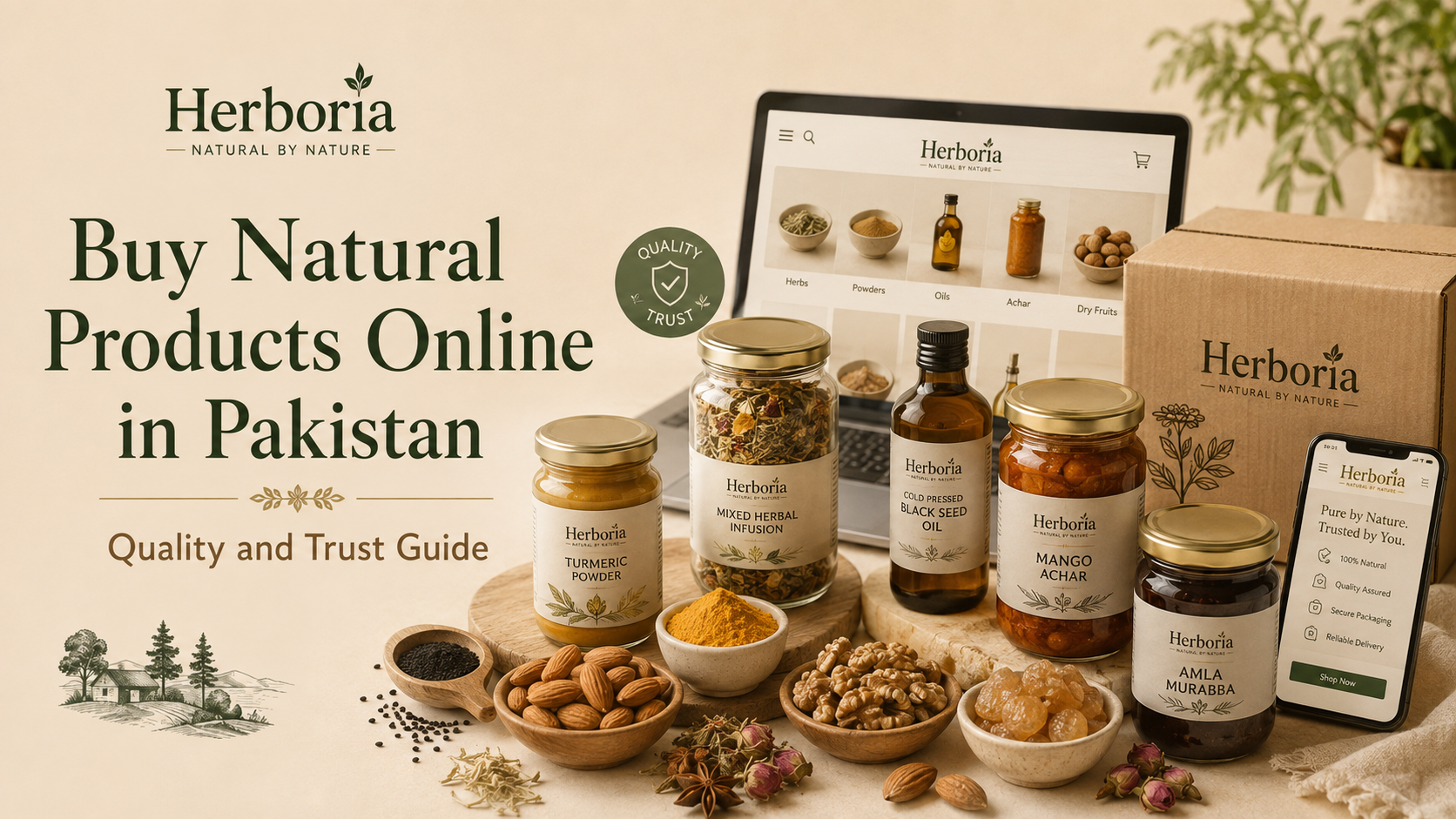
To buy natural products online in Pakistan with more confidence, check the product identity, ingredient list, intended use, pack size, seller details, storage instructions, delivery terms and the evidence behind any health claim. “Natural” is a broad marketing description, not a guarantee that a product is pure, effective, food-grade or suitable for everyone.
Pakistan’s online market includes herbs and pansar items, spices, seeds, dry fruits, pickles, murabba, oils, skin-care products and fresh foods. These categories have different quality and safety requirements, so a good buying decision starts by asking the right questions for the type of product you are actually ordering.
Start shopping: Herboria Shop
What Does “Natural Product” Mean Online?
Online stores use the word natural for many different products: whole herbs, powders, seeds, spices, oils, foods, pickles, preserves and topical skin-care items. The term alone does not tell you whether a product is organic, unprocessed, edible, cosmetic, medicinal or free from additives.
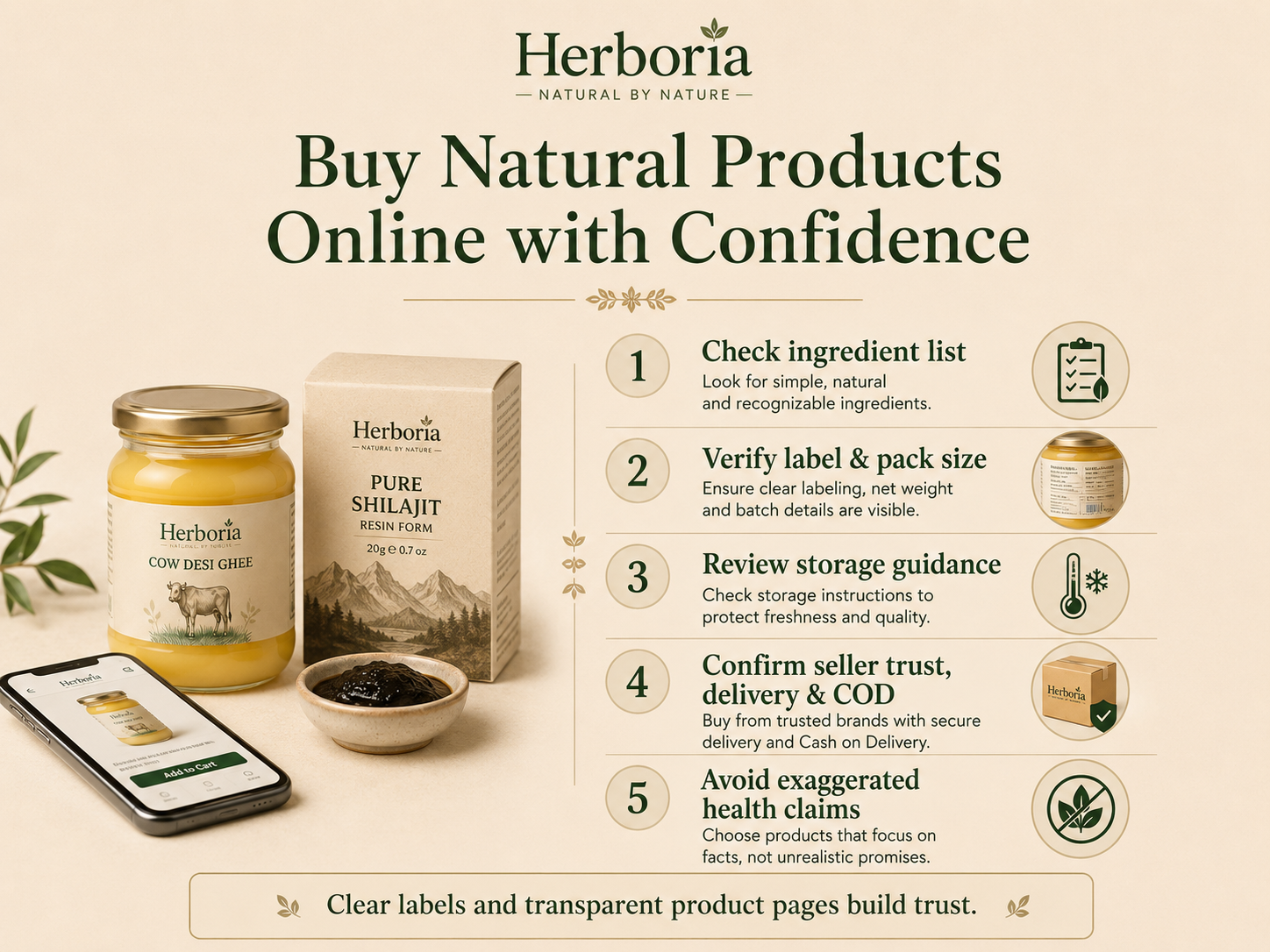
A trustworthy listing should therefore explain what the product actually is. Look for the common name, local or Urdu name where useful, ingredient declaration, product form, intended use, pack size, storage instructions and precautions.
Start With Product Identity
Many Pakistani herbs and pansar items have several local names. Confusion can also happen when one English name is used for more than one botanical material. Before purchasing, make sure the listing identifies the product clearly enough for your intended use.
For example, “neem powder” should clarify whether it is neem leaf powder and whether the product is intended for topical use. “Desi ghee” should identify the milk source where relevant. “Almonds” should state whether they are in-shell or kernels and whether they are raw, roasted or salted.
Read the Ingredient List, Not Just the Front Label
The front of a pack is designed to attract attention. The ingredient information is where you learn what you are actually buying. This is particularly important for blended masalas, pickles, preserves, herbal mixes, oils and skin-care products.
Words such as “traditional,” “premium,” “desi” and “natural” can describe positioning, but they should not replace a clear ingredient declaration. If an ingredient is important because of allergy, dietary preference or religious requirements, verify it before ordering.
Check the Intended Use
One of the most important online buying checks is whether the item is intended for food, topical use or another household purpose. A herbal powder sold for a face or hair mask should not automatically be consumed. An essential oil should not automatically be treated like an edible cooking oil.
If the intended use is unclear, ask the seller rather than guessing. This simple step prevents many avoidable mistakes.
How to Judge Quality Without Falling for Marketing Claims
Look for specific, verifiable information
Useful claims include product form, ingredient, origin where known, pack weight, storage requirement and clearly described processing. Vague statements such as “best in Pakistan” or “100% cure” do not tell you how the product was verified.
Accept natural variation
Herbs, spices, seeds, nuts and other agricultural products can vary in colour, size, shape and aroma between batches. Perfect visual uniformity is not always a sign of better quality.
Watch for meaningful warning signs
Damaged seals, moisture, visible mould, pest activity, unusual odour, leakage or a product that does not match its description matter more than viral “purity tests.”
Check Packaging and Storage
Packaging should suit the product. Powders and dry herbs need protection from moisture. Pickles and murabba need containers that remain tightly closed. Oils need secure bottles. Dry fruits should be protected from humidity and pests.
Pakistan’s heat and humidity make storage especially important. A product may be perfectly acceptable when dispatched but lose quality quickly if it is left open beside a stove, in direct sunlight or exposed to moisture.
Check the Seller, Not Only the Product
A reliable ecommerce store should provide clear contact information, delivery terms, payment options and product details. Policies should be understandable before checkout rather than hidden after payment.
Useful trust signals include:
- clear product names and descriptions;
- consistent category structure;
- visible pack sizes and pricing;
- realistic product images;
- delivery and return information;
- contact details;
- clear payment methods;
- reasonable, non-medical product claims.
Cash on Delivery vs Advance Payment
Many Pakistani shoppers prefer Cash on Delivery because it reduces hesitation when ordering from a new store. Advance payment may also be useful where offered. Herboria currently supports both Cash on Delivery and advance-payment options for standard Pakistan orders.
Payment method alone does not prove product quality, but transparent options and clear order communication are part of a trustworthy customer experience.
Delivery Matters for Different Product Types
Shelf-stable herbs, spices, dry fruits, pickles, oils and similar products can usually travel through normal ecommerce delivery when packed correctly. Fresh prepared produce has different requirements.
Herboria’s Fresh & Ready to Cook vegetable service is currently available only in Lahore. Orders placed by 10 PM are freshly prepared and delivered the next day in Lahore. Buyers outside Lahore should not assume the fresh-vegetable service follows the nationwide shipping model used for shelf-stable categories.
How to Evaluate Health and Wellness Claims
This is one of the most important trust checks when you buy natural products online in Pakistan. Traditional use, food use and scientific evidence are not the same thing.
A seller can responsibly explain that an herb has a traditional use or that a food contains certain nutrients. It is different to claim that a product treats diabetes, cures infertility, reverses hair loss or replaces prescribed medicine. Claims of that kind require strong evidence and should not be accepted simply because the ingredient is natural.
For pregnancy, medicines, chronic conditions, allergies or children, qualified professional guidance may be necessary.
Category-by-Category Buying Checklist
Herbs & Pansar Items
Check common name, Urdu name, botanical identity where useful, plant part, whole vs powder form, intended use and storage. Explore Herbs & Pansar Items.
Spices & Masalas
Check whole vs ground form, blend ingredients, chilli level where relevant, pack seal and freshness. Explore Spices & Masalas.
Seeds & Superfoods
Check seed identity, raw or roasted status, added ingredients and food-use directions. Explore Seeds & Superfoods.
Dry Fruits & Nuts
Check variety, shell status, roasting or salting, freshness, allergens and pack size. Explore Dry Fruits & Nuts.
Achar & Pickles
Check the main fruit or vegetable, oil or acidic medium, salt, spices, allergens, seal and storage directions. Explore Achar & Pickles.
Chutneys & Preserves
Check fruit content, added sugar, ingredient list, packaging and storage after opening. Explore Chutneys & Preserves.
Natural Oils
Check whether the oil is edible, cosmetic or essential; review source ingredient, extraction description, packaging and intended use. Explore Natural Oils.
Natural Skin Care
Check full ingredients, intended skin area, patch-test guidance where appropriate, allergens and realistic claims. Explore Natural Skin Care.
Gift Boxes & Bundles
Check exactly what is included, individual pack sizes, recipient allergies, delivery timing and packaging. Explore Gift Boxes & Bundles.
Fresh & Ready to Cook
Check cut style, pack weight, chilled/fresh status, delivery area and refrigeration instructions. Explore Fresh & Ready to Cook.
Questions to Ask Before You Click “Buy”
- Do I know exactly what this product is?
- Is the intended use clear?
- Are the ingredients disclosed?
- Does the pack size suit how quickly I will use it?
- Are storage directions provided?
- Are any medical claims exaggerated?
- Does the seller provide delivery and payment information?
- Can I contact the seller if something is unclear?
- Is this product appropriate for my allergies or dietary restrictions?
Where to Buy Natural Products Online in Pakistan
Herboria’s Shop All page lets shoppers compare products across herbs, spices, seeds, dry fruits, pickles, preserves, oils, skin care, gifting and fresh prepared produce. Use category pages to narrow the range, then review the individual product page before ordering.
Related Buying, Quality & Trust Guides
This is the pillar article for Herboria’s Buying, Quality & Trust cluster. Supporting articles HB-129, HB-130 and HB-131 will link back here and cover narrower buying and trust questions. Direct URLs will be inserted after publication to avoid deliberate 404 internal links.
Frequently Asked Questions
How can I buy natural products online in Pakistan safely?
Check product identity, ingredients, intended use, packaging, storage instructions, seller details, delivery terms and whether claims are specific and realistic.
Does “natural” mean a product is automatically safe?
No. Natural ingredients can still cause allergies, irritation, interactions or dietary problems. Suitability depends on the ingredient, intended use and individual user.
How should natural products be stored?
Follow the product label. Dry goods generally need protection from heat and moisture, while fresh products may require refrigeration and a different delivery model.
What precautions apply to herbs and wellness products?
Avoid unsupported treatment claims. For pregnancy, medicines, chronic conditions, allergies or children, seek qualified professional guidance when appropriate.
Where can I explore Herboria products in Pakistan?
Visit the Herboria Shop and use the category pages to compare current products, pack sizes and pricing.
Editorial Note
This guide is designed to improve buying decisions and product literacy. It does not treat the word “natural” as evidence of medical effectiveness or universal safety.