Blog
Desi Ghee in Pakistan: Types, Uses and Buying Guide

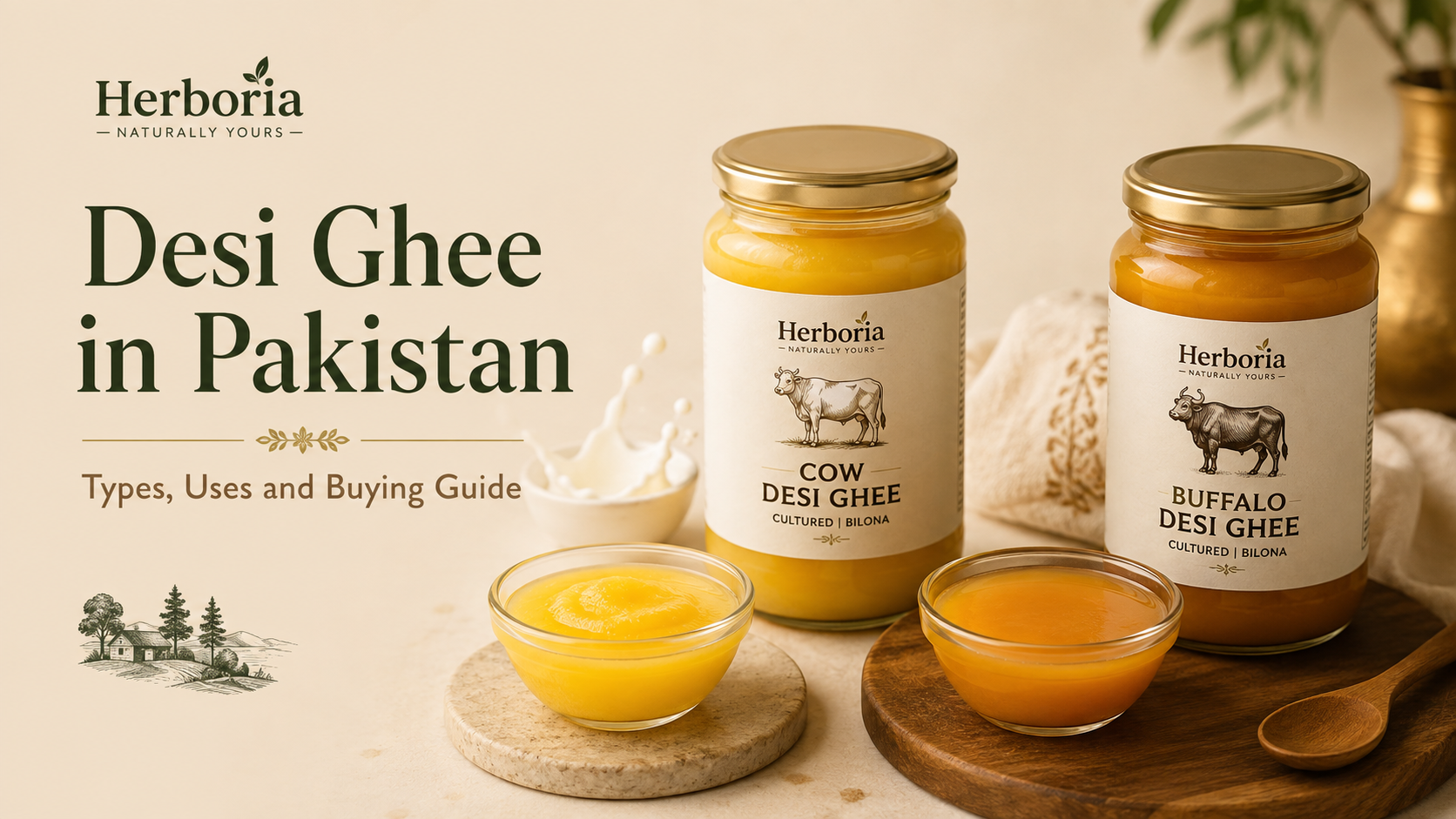
Desi ghee is a clarified dairy fat made by heating butter or other milk-fat sources so that most water and non-fat milk solids are removed. In Pakistan, it is widely used for paratha, daal, rice, halwa, frying and traditional cooking. The two common choices are cow desi ghee and buffalo desi ghee, which can differ in aroma, colour and texture.
For Pakistani shoppers, choosing desi ghee is less about finding one universally “best” type and more about matching the product to your cooking style, taste preference, ingredient expectations and storage needs. This guide explains the main types of desi ghee in Pakistan, how they are commonly used, what to check on a label and how to store ghee without relying on unsupported purity myths.
What Is Desi Ghee?
Ghee is a concentrated milk-fat product created through clarification. Food standards describe ghee as a milk-fat product made by removing almost all water and non-fat milk solids while developing the characteristic flavour and texture associated with ghee. In everyday Pakistani usage, the term desi ghee usually refers to traditional dairy ghee made from cow or buffalo milk.
Clarification changes butter into a more concentrated cooking fat with a distinct aroma and a texture that can vary with temperature. Because ghee is still a dairy-derived food, people with a milk allergy or those following a vegan diet should not treat it as dairy-free simply because most milk solids have been removed.
Desi Ghee in English and Urdu
In English, it is commonly called ghee, clarified butter or clarified milk fat. In Urdu it is written as دیسی گھی. You may also see product descriptions such as گائے کا دیسی گھی for cow desi ghee and بھینس کا دیسی گھی for buffalo desi ghee.
These names are useful when comparing products online because the milk source should be clearly stated instead of being hidden behind a generic “pure ghee” description.
Main Types of Desi Ghee in Pakistan
1. Cow Desi Ghee
Cow Desi Ghee is prepared from cow milk fat. Herboria’s current cow ghee listing describes it as suitable for cooking, frying and baking, including familiar Pakistani foods such as paratha, daal, rice, halwa and desserts.
Cow ghee is often selected by households that prefer its particular dairy aroma and flavour profile. Colour can vary between batches and should not be treated as a stand-alone purity test. Natural feed differences, processing and storage conditions can all affect appearance.
2. Buffalo Desi Ghee
Buffalo Desi Ghee is prepared from buffalo milk fat. Herboria’s listing describes a rich dairy aroma, traditional desi flavour and a smooth, dense texture suitable for cooking, shallow frying, baking and traditional recipes.
For buyers, the useful question is not whether buffalo ghee is automatically “better” than cow ghee. The more practical comparison is which taste, texture and cooking behaviour you prefer and whether the product is clearly labelled with its actual milk source.
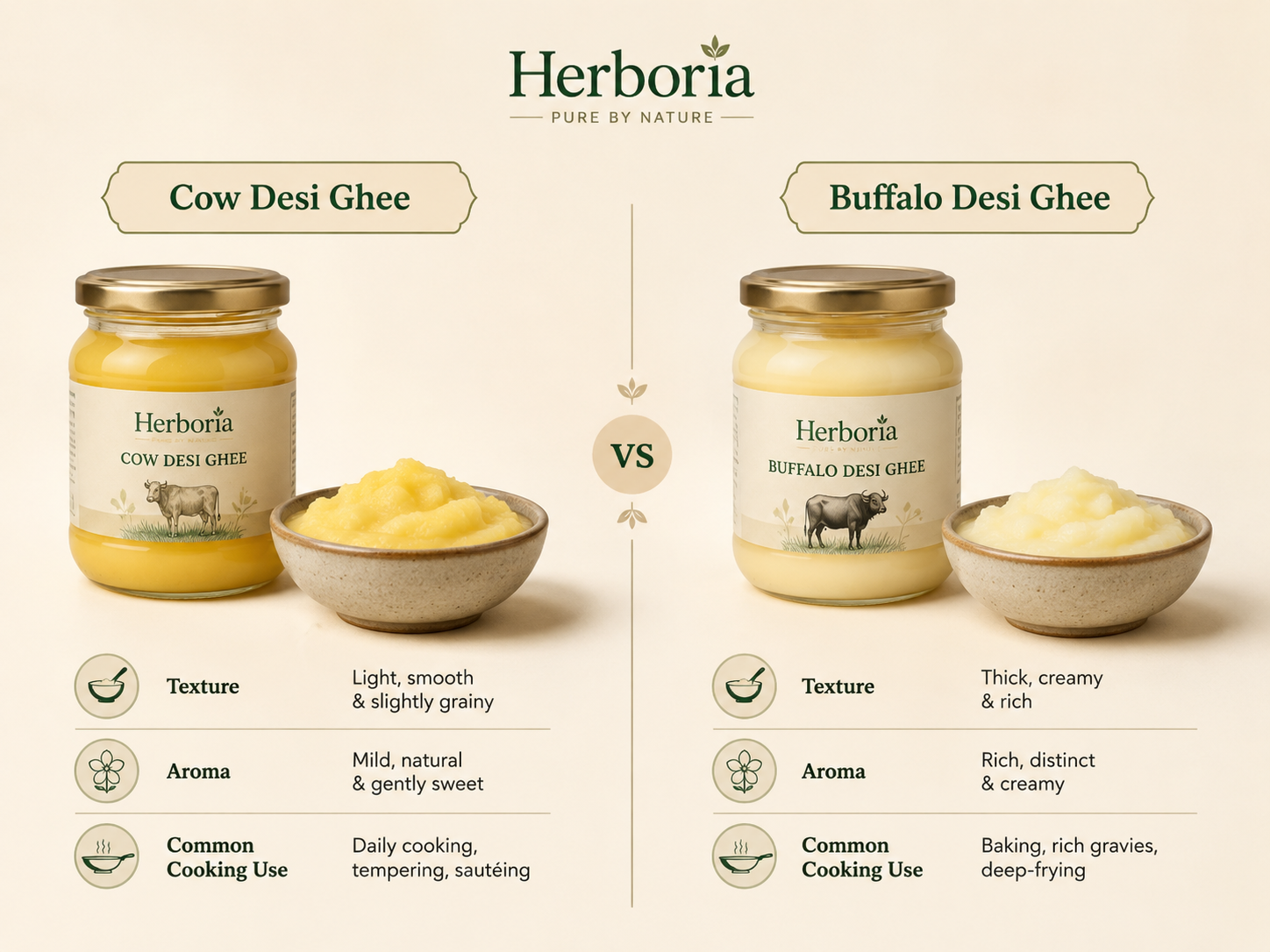
Cow Desi Ghee vs Buffalo Desi Ghee
| Factor | Cow Desi Ghee | Buffalo Desi Ghee |
|---|---|---|
| Milk source | Cow milk fat | Buffalo milk fat |
| Common use | Everyday cooking, paratha, daal, rice, baking and sweets | Everyday cooking, paratha, rice dishes, frying, baking and sweets |
| Texture | Can range from firm or grainy to soft or liquid depending on temperature | Can also become firm, soft or liquid depending on temperature |
| Best choice for | People who prefer the taste and aroma of cow-milk ghee | People who prefer the taste and richness of buffalo-milk ghee |
Neither type should be judged only by colour or whether it is solid at room temperature. Ghee texture naturally changes as ambient temperature changes, which is especially noticeable between Pakistani summers and winters.
How Desi Ghee Is Commonly Sold in Pakistan
Desi ghee is commonly sold in sealed jars, bottles or tubs in different household pack sizes. When comparing products, focus on information that can actually be checked: milk source, ingredient statement, pack weight, packaging condition, storage directions, best-before information and seller details.
The words desi, traditional or pure may describe positioning, but they are not a substitute for a clear ingredient declaration. A more useful product page tells you whether the ghee is cow or buffalo based, how it is packed and how it should be stored after opening.
How Is Desi Ghee Commonly Used in Pakistani Cooking?
Desi ghee is a versatile cooking fat. In Pakistan, common uses include:
- cooking paratha and roti;
- tarka for daal and lentils;
- rice, pulao and biryani;
- halwa, panjeeri and traditional desserts;
- shallow frying and sautéing;
- baking where a rich dairy flavour is desired; and
- adding a small amount to a warm finished dish for aroma and flavour.
The amount used is a matter of recipe, taste and individual dietary needs. A food guide should not turn a cooking ingredient into a medical prescription, so claims that a fixed daily dose of ghee will treat or prevent a condition should be treated cautiously.
Choosing Desi Ghee for Different Kitchen Uses
If you mainly want ghee for paratha, daal and everyday cooking, either cow or buffalo ghee can work; flavour preference may be the deciding factor. For halwa, panjeeri and traditional desserts, some households prefer a stronger dairy aroma. For baking or recipes where the fat contributes noticeably to flavour, compare the two types in small batches and choose the one that suits your recipe.
There is no need to turn these preferences into universal rules. Cow and buffalo ghee can both be used across many of the same dishes. The best choice depends on your household’s taste, recipe and dietary requirements.
What Should You Check Before Buying Desi Ghee?
Check the ingredient statement
Start with the simplest question: what is actually in the jar or bottle? If you are buying cow ghee, the label should identify cow milk fat or an equivalent verified description. If you are buying buffalo ghee, the milk source should be clear. Avoid assuming that words such as “desi,” “natural” or “traditional” automatically prove composition.
Check the milk source
A generic ghee listing can make comparison difficult. Clear differentiation between cow and buffalo ghee helps shoppers choose according to preference and also reduces confusion for households that deliberately use one milk source.
Check packaging and sealing
Ghee should be packed in a clean, food-appropriate container that can be closed tightly. A secure seal matters because moisture, dirty utensils and food particles can reduce product quality after opening.
Check the storage and best-before directions
Follow the specific storage directions printed on the product you purchase. Do not replace label instructions with viral home-storage advice. For Herboria’s cow and buffalo desi ghee, the current product guidance says to keep the container tightly closed, store it in a cool, dry place away from excessive heat and direct sunlight, and use a clean, completely dry spoon.
Check the seller and product information
When you buy desi ghee online in Pakistan, look for a seller that provides a clear product name, milk source, pack size, ingredient information, storage guidance, contact details and transparent delivery terms. Clear labelling is more useful than exaggerated claims about “miracle” health benefits.
Can Colour, Graininess or a Home Test Prove Ghee Purity?
No single visual sign can reliably prove purity. Colour can vary with milk source, feed, processing and batch conditions. Texture can shift between liquid, semi-solid and firm states as temperature changes. Graininess can also vary. These physical differences are not, by themselves, laboratory evidence of purity or adulteration.
Likewise, popular home tests circulating on social media should not be presented as definitive quality-control methods. If authenticity is important, use traceable product information, trustworthy sourcing and, where necessary, appropriate laboratory analysis rather than a kitchen myth.
Why Does Desi Ghee Become Liquid in Summer and Firm in Winter?
Ghee contains a mixture of fats with different melting characteristics. As room temperature rises, it can soften or become liquid; as temperature falls, it can become firmer or grainier. Pakistan’s seasonal temperature swings make this change particularly visible.
A change in physical state does not automatically mean the ghee has spoiled. More relevant warning signs include an unusual off-odour, visible contamination, water entering the container or storage beyond the labelled best-before guidance.
How to Store Desi Ghee After Opening
- Keep the lid tightly closed. Limit unnecessary exposure to moisture and kitchen contaminants.
- Use a clean, dry spoon. Water or wet utensils should not be introduced into the container.
- Keep it away from excessive heat and direct sunlight. Follow the product label for exact storage conditions.
- Do not mix food particles into the jar. Scoop out what you need rather than dipping a used utensil back into the ghee.
- Follow the best-before date and label directions. Manufacturer guidance should take priority over generic online advice.
Desi Ghee and Nutrition: Keep the Claims Realistic
Desi ghee is a concentrated source of dietary fat. It also contains saturated fat, so it should be considered within the context of your overall diet rather than marketed as a treatment, cure or guaranteed wellness shortcut. Current cardiovascular nutrition guidance generally recommends replacing some sources of saturated fat with unsaturated fats and looking at the whole dietary pattern rather than treating one food as uniquely healthy or unhealthy.
If you have a medically restricted diet, a diagnosed cardiovascular condition, a milk allergy or another condition affected by dietary fat, follow guidance from an appropriately qualified healthcare professional. Children, pregnancy and other special circumstances may also require individual advice rather than generic internet recommendations.
Buying Desi Ghee Online in Pakistan
Online buying is convenient, but do not choose only by a product photograph or a dramatic purity claim. Review the complete product page, including ingredient details, pack size, storage guidance and delivery information. If an important detail is missing, ask the seller before ordering.
For nationwide ecommerce, it is also useful to check payment methods and the seller’s delivery terms before checkout. Herboria’s current store policy offers delivery across Pakistan with Cash on Delivery and advance-payment options for its standard shelf-stable products.
Where to Buy Desi Ghee in Pakistan
If you are comparing options, begin with the broader Herboria Natural Oils category and then review the specific product details for Cow Desi Ghee or Buffalo Desi Ghee.
Herboria’s product pages state the milk source, common cooking uses, packaging and storage guidance so buyers can compare the two options without relying on vague purity language. Availability, pack size and current pricing should always be checked directly on the product page because these can change over time.
Quick Buying Checklist
- Is the milk source clearly stated?
- Does the ingredient information match what you intend to buy?
- Is the pack securely sealed and clearly labelled?
- Are storage directions and a best-before date provided?
- Does the seller avoid unsupported cure or disease claims?
- Can you easily find contact, delivery and payment information?
- Are you choosing cow vs buffalo ghee based on preference rather than a viral purity myth?
Related Desi Ghee Guides
This article is the pillar guide for Herboria’s Desi Ghee topic cluster. Upcoming supporting guides will cover cow vs buffalo ghee in more detail, how ghee is clarified, desi ghee vs butter, cooking uses, storage, seasonal texture changes, quality checks, frying and baking, online buying and responsible evaluation of health claims.
As those guides are published, this section will be updated with direct internal links so readers can move naturally from this overview to the specific question they want answered.
Frequently Asked Questions
What is desi ghee in Pakistan?
Desi ghee is a clarified dairy fat traditionally made from milk fat, commonly from cow or buffalo milk. It is used in Pakistani cooking for paratha, daal, rice dishes, frying, halwa and other traditional foods.
How is desi ghee commonly used?
It can be used for cooking, shallow frying, baking, tarka, rice dishes, paratha and traditional sweets. The most suitable use depends on the recipe and the flavour you want.
How should desi ghee be stored?
Follow the product label. In general, keep the container tightly closed, use a clean and completely dry spoon, protect it from moisture and unnecessary heat, and follow the best-before date.
What precautions apply to desi ghee?
Ghee is dairy-derived and unsuitable for vegan diets. People with milk allergy or medically restricted diets should seek appropriate professional guidance. It is a concentrated fat and should not be promoted as a treatment or cure.
Where can I explore Natural Oils in Pakistan?
You can browse the Herboria Natural Oils collection and compare the current Cow Desi Ghee and Buffalo Desi Ghee listings, including available sizes, pricing and product-specific guidance.
Sources and Editorial Notes
This guide was prepared using Herboria’s current Cow Desi Ghee and Buffalo Desi Ghee product information, Herboria’s Natural Oils category structure, recognised food-standard definitions of ghee, and current evidence-based dietary guidance on saturated fat. Product details should be checked against the latest label and listing before purchase.
- Food Safety and Standards Authority of India (FSSAI) — food-standard definition and composition context for ghee.
- American Heart Association — current guidance on saturated fat within an overall dietary pattern.
Herboria editorial note: This article is educational and does not provide medical diagnosis or treatment advice. Product claims should match verified product labels and specifications.